
TranSPORT Forum 2026: nobody agreed on much, and that's exactly why I came away reassured
I spent Wednesday 8 July at Kings Place in London, at SVG Europe's TranSPORT Forum, and I've been turning one thing over in my head ever since. Across a keynote and four panels, I didn't hear a single argument settled. Cloud versus on-prem, satellite versus IP, public 5G versus private, every one of them was still live, still contested, still being argued out by people who build this stuff for a living.
A few years ago that would have worried me. This year it didn't, and I think I know why. The industry used to talk about these choices as if one of them was destined to win outright. Cloud would swallow everything eventually, satellite was on its way out, and anyone still running dedicated infrastructure was quietly the person holding the room up. Nobody at TranSPORT Forum was making that argument any more. What I heard instead, from vendors and rights-holders alike, was a far more grown-up conversation: not which technology wins, but which combination earns its place on a given job. That happens to be the conversation we have with clients at Levira Media Services most weeks of the year, so it was good to hear an entire industry arrive at it independently.
An owned core, and edges that flex
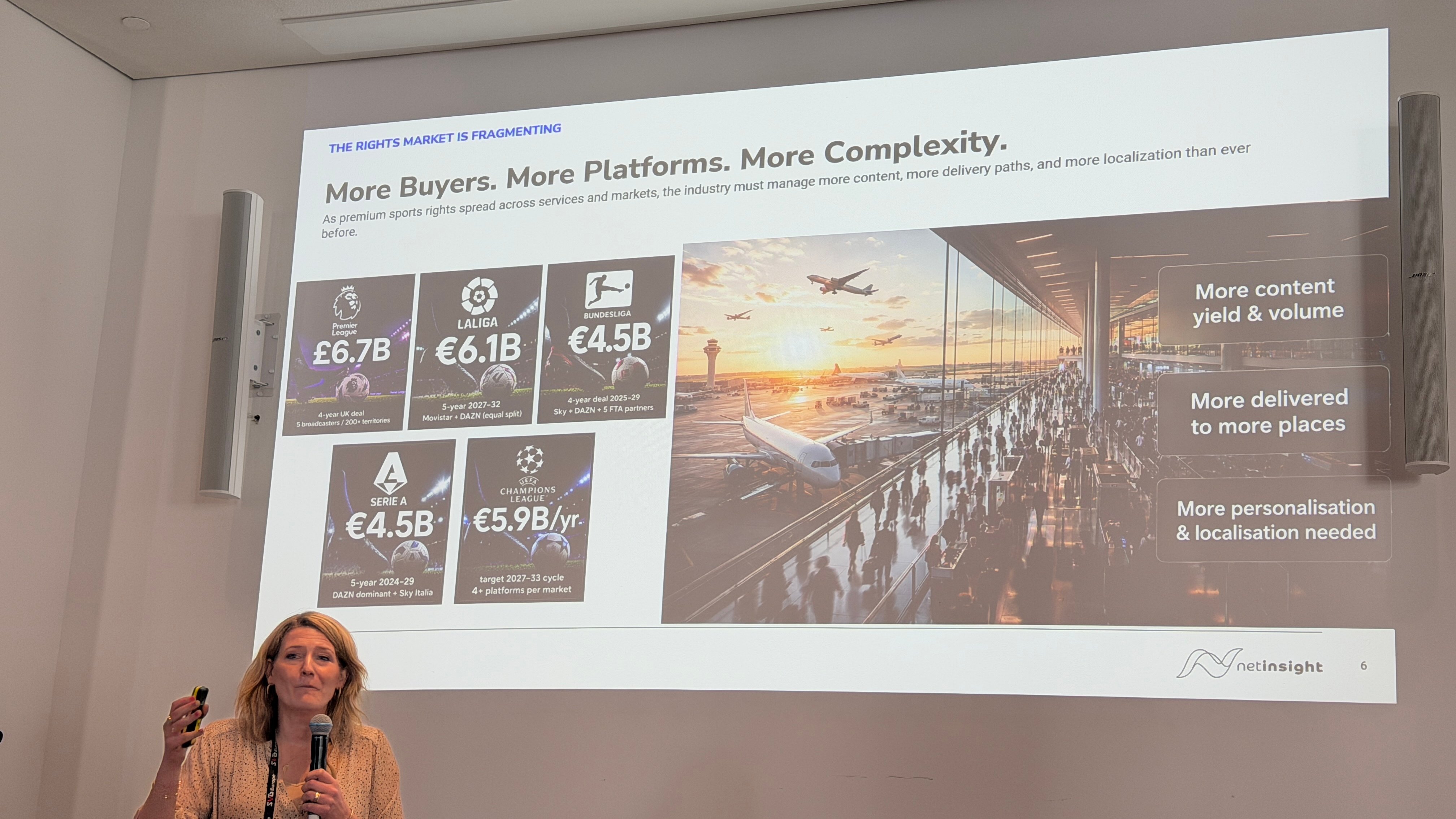
Larissa Görner-Meeus opened the day as Net Insight's newly appointed Chief Product Officer, and rather than pitch products, she talked about a correction. The industry spent a few years assuming cloud economics would only get better and eventually take over everything. Instead, hyperscaler pricing has moved the wrong way with compute costs roughly tripling over five years, memory rising even faster. That has brought owned, on-premise infrastructure back into the conversation as a genuine peer to cloud, rather than a legacy fallback.
The panel that followed, with speakers from Warner Bros. Discovery, NEP Connect, LiveU, Quortex and Net Insight, showed what that looks like in practice. Nobody there was picking cloud or dedicated infrastructure once and living with it. The choice gets made per event now, sometimes per hour, and billing has followed suit, what used to be priced by the month is increasingly priced by the week, or by the window around a single fixture. Satellite got a mention too, and not as something on its way out, it's simply one option among several rather than the default it once was.
The cloud panel, with Overcast, Globecast and Zixi, made the same point from the buyer's side. Overcast's Nicolas Déal argued for private cloud in dedicated physical data centres rather than the contended public internet, on the basis that live production needs a determinism you can't fully bank on with shared infrastructure. Globecast's Steve MacMurray put it more simply: cloud capacity is a rented flat for the busy weeks, not a second house you buy and barely use. What struck me listening to both is that neither was really talking about saving money. They were talking about certainty, knowing what something will cost, and knowing it will hold up under pressure, which is worth more to most broadcasters than a lower headline number.
That's more or less the case we make for our own architecture at Levira. We run an owned, dedicated core precisely so cloud can be the flexible edge rather than the whole foundation. Hearing three separate sessions land on that same shape, unprompted, was about as close to external validation as this business gets.
Nobody's buying a single vendor any more
The second thread running through the day was complexity, specifically how fragmented modern sports rights have become. Görner-Meeus raised it first with major tournaments now split across a growing list of broadcasters, platforms and territories, and some of the biggest rights-holders have simply stopped waiting for an off-the-shelf platform to catch up, building their own orchestration layers instead.
The federations panel put numbers on it in a way I found genuinely striking. Volleyball World produces around 4,000 matches a year and distributes another 2,000 on top, and of all that volume, satellite now carries only about 300 matches, everything else moves over IP. With roughly sixty takers on a single match, each often wanting a different flavour of the feed, they told the room that chasing broadcasters by email had simply stopped working, so they built their own booking and rights-management tooling instead. One that opens and closes streams automatically to protect the rights deal, and pulls taker data back in through APIs rather than a chain of emails. World Archery, running a fraction of the budget and headcount, reached a related conclusion by a leaner route, a compressed, IP-first production core, and an 'auto-open, help yourself' distribution model that lets smaller events find an audience without a person on the other end of every request.
What I took from both stories, and from the vendors who'd echoed the same thing earlier in the day, is that loyalty to a single vendor or a single delivery method isn't how anyone's building any more. The value has shifted to interoperability because the alternative is being stuck with infrastructure sized for last year's rights deal, not this year's. That's exactly the position we try to hold for our clients at Levira: a reliable core they don't have to think about, and enough flexibility at the edges that a new rights structure or a new taker doesn't mean starting again from scratch.
Private 5G has outgrown the camera story
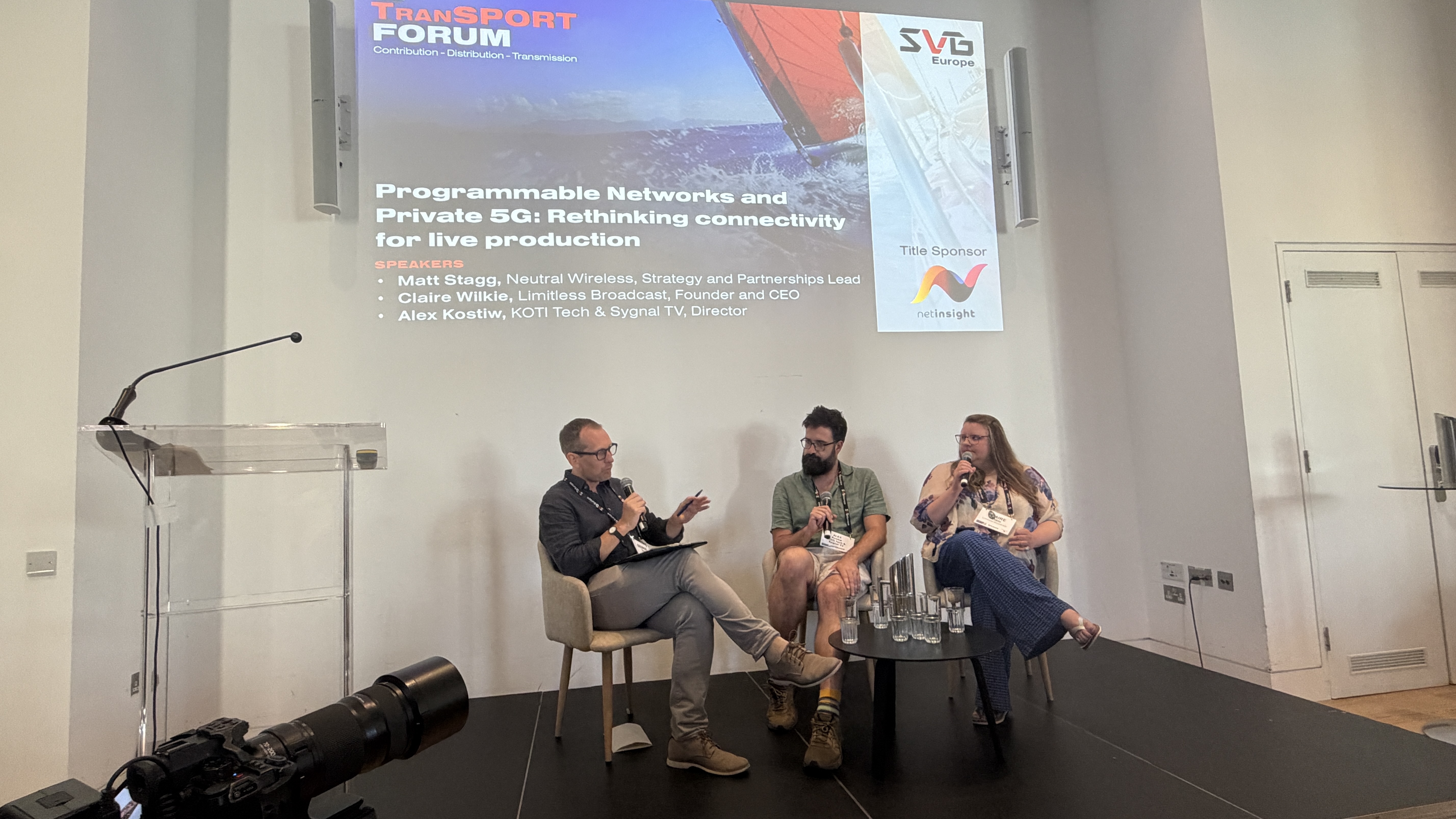
The session that shifted my thinking the most was on programmable networks and private 5G, with Neutral Wireless, Limitless Broadcast, and KOTI Tech & Sygnal TV. I went in assuming the topic would be wireless cameras, by the end that felt like a fairly small part of the story.
The panel's real argument was that a private 5G network, once it's up, becomes a full IP production layer, not just cameras, but comms, tally, return feeds, control systems, telemetry, even point-of-sale and payment systems, all riding the same infrastructure. Limitless Broadcast's Claire Wilkie described this year's Henley Royal Regatta as a working example of exactly that. They installed three antennas along the course handing the signal seamlessly from one to the next as the boats moved, roughly twenty-three cameras including remotely operated units on chase boats, plus live race timing and stats, the whole production running on one private network built with Neutral Wireless. She credited Ofcom's new n40 short-notice spectrum licence with making that kind of rapid, short-term deployment commercially realistic. A ten-day turnaround that simply wasn't viable a couple of years ago.
To their credit, nobody on the panel oversold it. Fixed fibre still wins wherever it's already installed. Wi-Fi still wins in a corporate box or an office. Private 5G's job is to sit alongside those, filling the gap neither can, and it will become standard kit the day it's as easy to deploy as anything else in the production toolkit. It isn't quite there yet, but it's closer than I expected.
What the arrow taught me
The moment that's stayed with me longest came almost as a throwaway line on the archery panel. AI, apparently, still can't reliably tell the instant an archer releases the arrow. It's very good, though, at spotting the arrow landing. So World Archery built its automated production workflow entirely around the part the machine actually understands, and left the harder, more human moment to the humans.
I like that story because it's a small, honest version of the argument running under the whole day. Nobody at TranSPORT Forum was hunting for the one technology that solves everything. They were working out, piece by piece, which tool actually earns its place and were comfortable leaving the rest to people, or to a different tool entirely. It's not a dramatic conclusion, and it won't fit neatly on a conference slide. But it's true, and it's roughly the question our team at Levira Media Services gets asked most, not which technology should win, but which combination gets this particular job done properly.
If you were in the room on 8 July, I'd love to compare notes. And if any of this sounds like the conversation you're currently having about your own transmission and distribution setup, that's exactly the conversation we're set up to have. Get in touch with the team at Levira Media Services.