
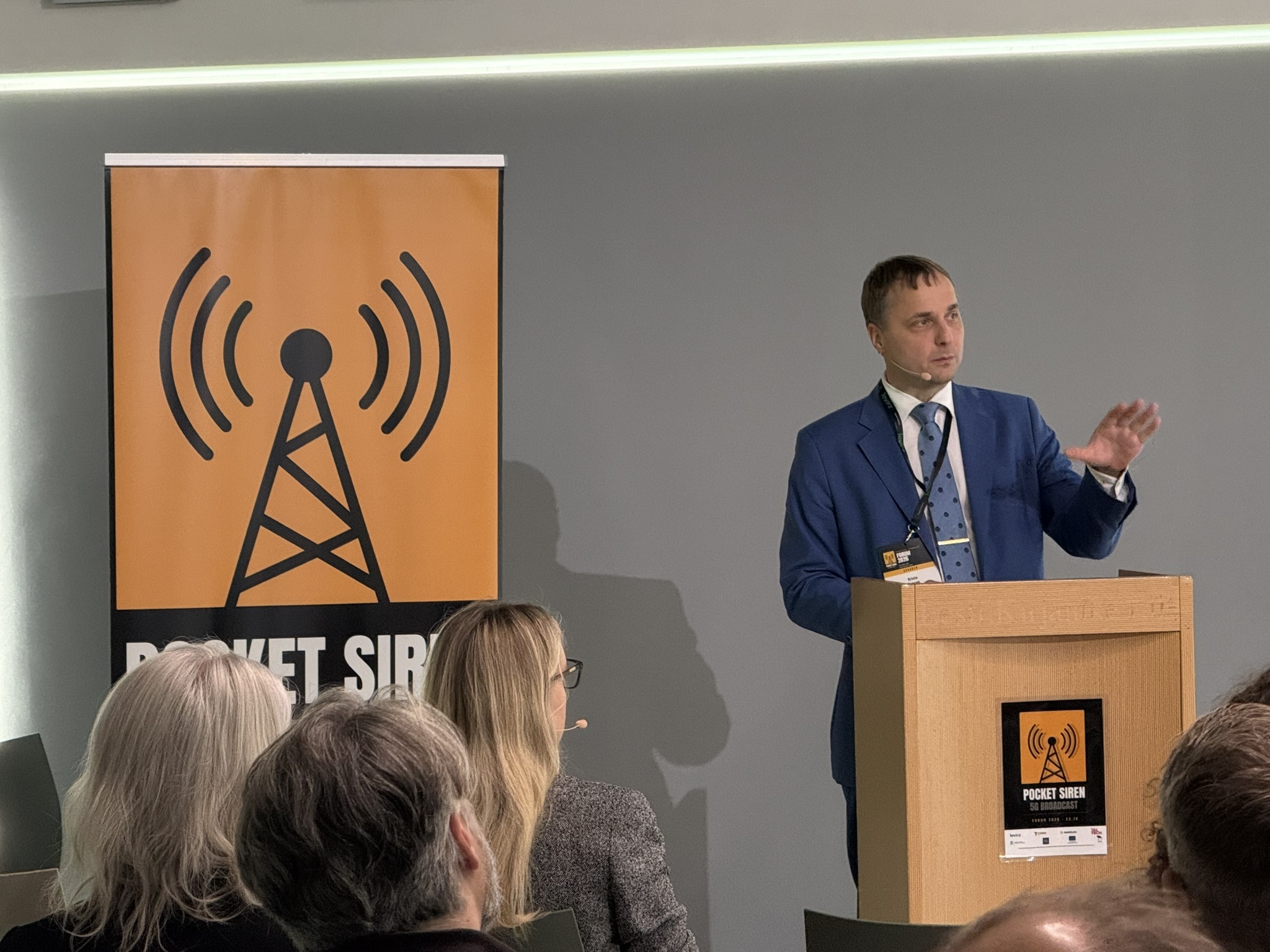
By Kristo Kaasan, Chief Technology and Information Officer, Levira
Public warning depends on channels that stay available under pressure. After two years of testing 5G Broadcast in Estonia through the Pocket Siren pilot, here is what we have learned about whether broadcast can be one of them.
Most of us rely on mobile networks for almost everything, and warning systems have followed. That works until the moment it matters most. When a storm takes out power, or a crisis puts every network under strain at once, the channel people expect to carry a warning is often the one that is struggling.
Estonia has seen this at first hand. Severe storms in 2019, 2022 and 2024 caused power outages that also disrupted mobile communications. For a country that has built so much of its success on digital services, the lesson is a serious one: the state must be able to keep people informed even when mobile networks and the internet are unavailable. Resilience comes from redundancy, and no single channel can promise that a message will reach everyone every time.
That is the question behind Pocket Siren (Taskusireen). It is a pilot and research initiative, commissioned by the Strategy Unit of the Government Office and funded under the European Union cohesion policy 2021–2027. Levira, TalTech, TRedess and Nakolos carry out the technical development and testing. It is not a replacement for existing warning channels, and it is not an operational nationwide service. It asks whether broadcast infrastructure, which is built to last, can give warning systems an additional route that does not depend on mobile network capacity.
Where broadcast fits
Estonia already has a layered system. The national EE-ALARM system brings location-based text messages, two mobile applications, broadcaster overlays and a siren network together under one point of activation. It is moving quickly. In a recent national test, text messages reached one million devices in 17 minutes, about twice as fast as a year earlier. Cell broadcast follows early next year.
5G Broadcast belongs further along that road. It adds a physical layer of redundancy, and it can carry things that cell broadcast cannot: pictures, video and audio. The same signal reaches ten devices or ten thousand at once, so there is no congestion.
What two years of testing showed
We put five transmitters on air, three high-power units of around three kilowatts and two medium-power fillers. We ran five test days and recorded more than 100,000 measurement points on land, at sea and from the air. Measuring from a helicopter, we picked up the signal from the Tallinn TV Tower 146 kilometres away. We tested with schoolchildren, older people and ordinary shoppers. According to our calibrated coverage model, the five pilot sites already reach around 80 per cent of the Estonian population with alerts.
Four findings stand out.
The technology works. I say that plainly, while accepting that there is room to improve it. Warnings are delivered, phones sound and vibrate, and updates follow.
The alert does not need a special phone. A 5G Broadcast warning uses the same technical message as mobile operator cell broadcast, so a handset does not need broadcast reception for the alert itself. At the highest alert level, phones sounded and displayed the message whatever their settings. The one exception was a handset with a physical mute switch. On our test devices, phones used their position to decide whether they were inside the warning area, and where they could not establish one, for example indoors, they showed the message anyway. We would rather someone receives a warning that does not apply to them than miss one that does.
Buildings are the hard part. Across 13 shopping centres in Tallinn we recorded reception in every one, but modern buildings behave like shelters, and metal and concrete blocked the signal in places. Coverage planning has to start from how people really live and move, not from a map of open ground.
Devices are the open question. When we began, two handsets from two manufacturers could show broadcast video. Today it is around ten models from four manufacturers, and at the end of the pilot we enabled picture reception on an ordinary retail Motorola phone by switching on software that was already there. The capability is in the modem; what is missing is software enablement. But the 600 megahertz band used for broadcast is not yet enabled in most phones, there is no iPhone support, and device-based geo-fencing is not yet active on commercial Android phones in Europe. Handsets can also show the same alert twice when a vehicle moves between two towers; we have identified a network-side fix, which still has to be confirmed in a drive test. None of these is a reason to stop, but the device issues need to be addressed with the device makers.
People decide whether a warning works
Technology only gets the message to the phone. After that, it is down to the person holding it. Our colleagues at TalTech gathered around 250 responses across test days in 2025 and 2026. In the first survey, which had 72 respondents, 96 per cent considered public warning messages necessary. 88 per cent found the on-screen display suitable, and 85 per cent found the language appropriate. Sound and vibration mattered: 81 per cent said the sound grabbed their attention and 76 per cent said vibration was necessary.
The samples were small and the scenarios simulated, so these findings are explanatory rather than representative. They do point somewhere useful. A missing child alert drew strong attention. A forest fire produced the highest perceived risk and the greatest willingness to act. A flooding scenario drew a more moderate response and showed the clearest need for plain, actionable instructions. A warning is only as good as its clarity.
What it would take to build
Our modelling suggests that adding about 15 sites to the five we have would bring around 96 per cent of the population into coverage. I would put the build at around 4.5 million euros including value added tax, with annual running costs of around one million. Over five years, that is around 9.5 million euros for a national 5G Broadcast network, compared with around 6.2 million for the cell broadcast investment already funded. That is a real difference, and it is why the infrastructure should not be judged on warning alone. If it carries even one further service, the cost of the warning layer falls by about half.
On timing, Estonia needs to decide in 2027 how to proceed. Preparation would run through 2028, construction in 2029, and a full service would be possible from 2030.
Why the next step has to be shared
Pocket Siren has shown that the technology works. But Estonia cannot, on its own, make it matter. Warning does not stop at a border, and neither does the problem of device support, spectrum or policy.
There is no common European Union position on 5G Broadcast for emergency warning. Spectrum policy has to guarantee support beyond 2035. Device makers will build what a large enough market asks for, and one small country is not a large enough market. Every conversation I have with colleagues elsewhere in Europe begins in the same place: they are interested, they are watching, and they would like someone else to go first. Estonia has gone first. The next step is for others to join, so that what we have learned becomes something many countries can use.
Estonian officials have said they will take this to their Nordic and Baltic counterparts, and I hope they find a receptive audience. Other countries are already doing their part: France, Lithuania, Sweden and Poland among them. The work now is to bring those efforts together.
What comes next
To build on the success of this project, here is what I would ask for.
- Neighbouring countries and civil protection authorities: join us in testing. We would like to run 5G Broadcast across the Gulf of Finland between Helsinki and Tallinn, to see how handover and message delivery behave when an alert crosses a border. The same applies along every border in the region.
- Regulators and policy makers: put 5G Broadcast for emergency warning on the agenda in Brussels, and make sure spectrum is protected beyond 2035.
- Broadcasters and mobile operators: talk to each other early. The infrastructure can serve more than one purpose, and the business case improves with every service that shares it.
- Device makers: enable the broadcast band, add device-based geo-fencing, and bring iPhone support into the discussion.
- Every country planning a national build: start with the areas where mobile access is weakest, and treat 5G Broadcast as an addition to the warning systems you already have.
If you are weighing up the same questions, we would be glad to share what we have learned, including the final Pocket Siren report, which will be published in December, or in January at the latest.
